
Moore County Criminal Docket Searches
Felony records live with the District Clerk. Start with the Moore LGS search. The county FAQ walks users through a Guest Login: pick the office, choose the criminal record type, and apply whatever filters the screen offers for that choice. What the post-login screen contains stays behind the login itself, so do not assume specific name, date, court, status, or cause-number controls until you see them.
- Read the complaint, bond paper, citation, or notice for the issuing court and cause number.
- For a felony or county-level case, open LGS and choose the appropriate Moore office and Criminal type.
- Search with the exact cause number when available; otherwise use only the displayed fields.
- Open “More Information” for index detail and “Images” for eligible public documents.
- Call the clerk or coordinator to verify a current setting and copy status.
Class C and fine-only cases stay with a justice or municipal court, depending on venue. Pushing them into the district search wastes time. If you get zero results, the cause may be the wrong clerk, an older file, or a restricted case rather than a clean record.
Moore Felonies Start in District Court
The official 69th District Court page identifies the local district court and its administration.
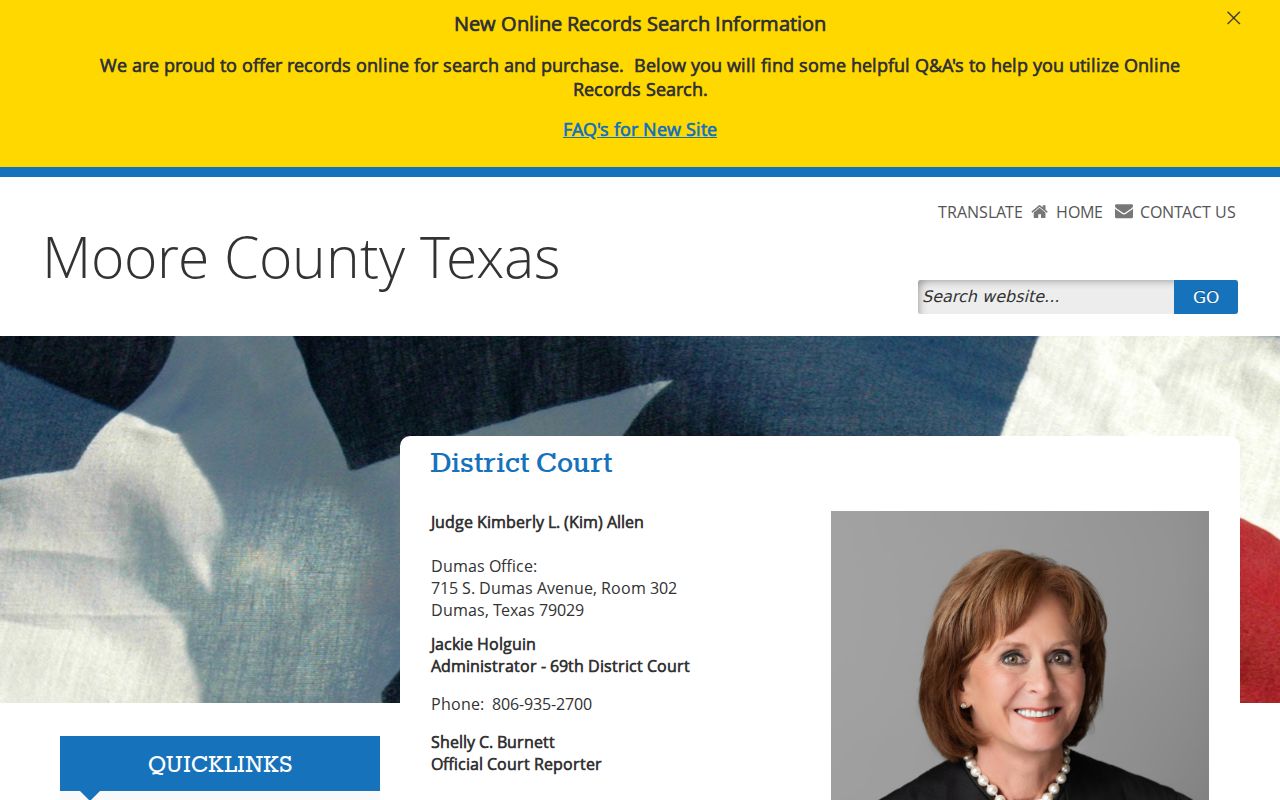
Felony files are District Clerk records. Court administration sits in Room 302, and the District Clerk's office is Room 109. The two do different jobs. For settings, call Jackie Holguin at 806-935-2700. For the filed district docket itself, District Clerk Mayra Rivero's office at 806-935-4218 owns the record. A coordinator can confirm a court date over the phone. That word never replaces a certified copy request.
Criminal Dockets: What They Show
A criminal docket reads like a timeline of the case. Entries can cover initiation, bond, arraignment, motions, settings, plea or trial, disposition, sentence, costs, and appeal. Moore County does not post a live criminal record view, so treat any local labels or abbreviations with care until a clerk confirms them.
| Header | Cause number, court, judge, filing date, status, and style when public. |
|---|---|
| Charge | Offense, statute, count, and degree or class; exact Moore labels were not observed. |
| Bond | Amount, type, and release events may appear, but the public layout was not seen. |
| Chronology | Filings, service, arraignment, motions, settings, pleas, disposition, and sentence. |
| Documents | Public complaints, indictments, orders, judgments, and images when allowed. |
| Restriction | A sealed, redacted, juvenile, expunged, or nondisclosure condition may limit display. |
A charge is only an allegation, never proof of guilt. A setting on the docket is not a result. Only the signed disposition or judgment states what the court actually did.
Moore Criminal Clerk Routing
The County Court at Law page names Judge Jerod Pingelton and coordinator Patsy Ortega. It also posts local rules, standing orders, and remote-hearing material.
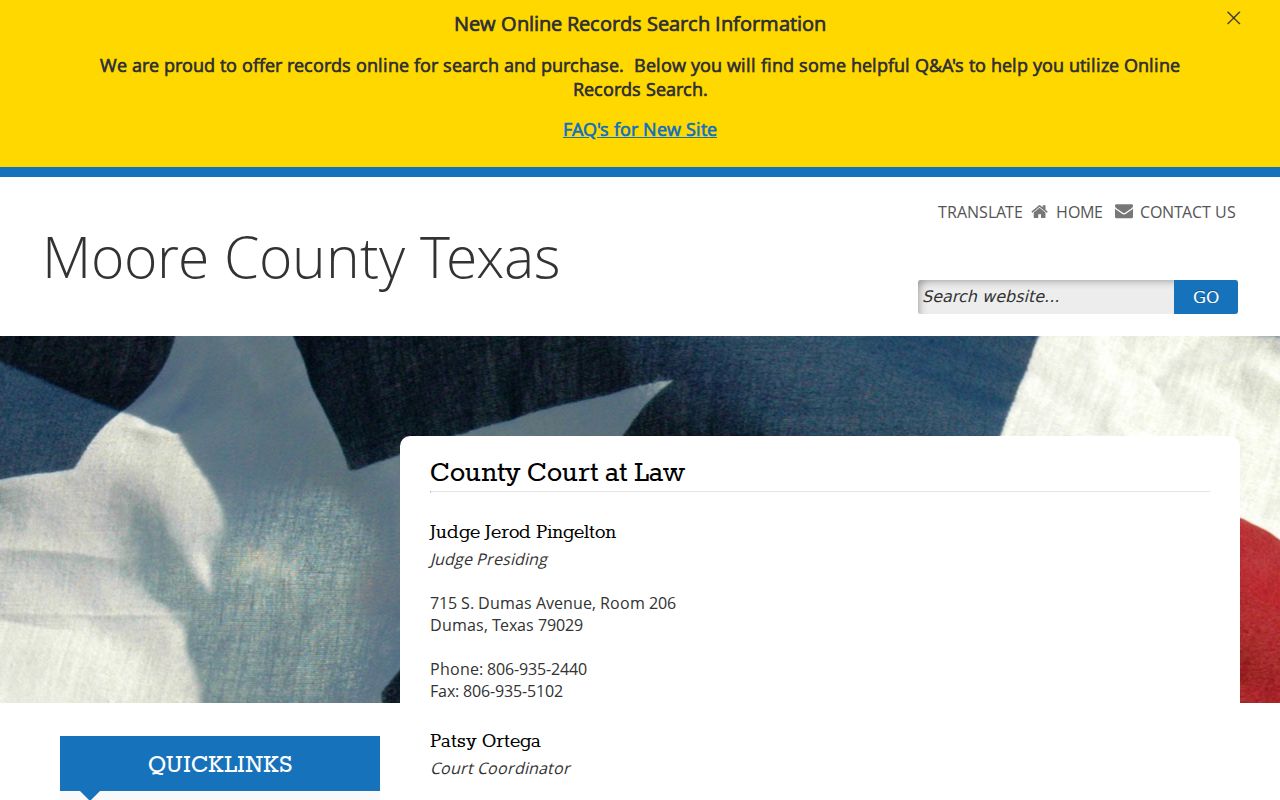
Class A and B misdemeanors usually land in the constitutional County Court. Others go to a statutory county court at law. Texas law provides for both. In Moore County, the constitutional County Court sits in Room 202. County Court at Law is Room 206. Always ask which clerk and which docket own the case. County Clerk Brenda McKanna keeps the constitutional county records. For setting questions, call the CCL coordinator at 806-935-2440.
| Offense level | Likely court route | Contact purpose |
|---|---|---|
| Felony | 69th District Court | District Clerk for file; administrator for setting |
| Class A or B misdemeanor | County Court or County Court at Law as assigned | County Clerk or confirmed statutory-court custodian |
| Fine-only Class C | JP or municipal court | Issuing precinct or city clerk |
Criminal Case Stages on the Docket
The usual sequence is filing → arraignment → pretrial → plea or trial → disposition → sentencing. Each arrow represents a possible set of entries, not a promise that every Moore case uses the same labels. Initiation may be by complaint, information, or indictment. Pretrial entries can include attorney appearances, discovery, motions, subpoenas, and settings.
Arraignment is where the charge and plea process moves forward. Later docket entries may show a plea or a bench or jury trial. Some show dismissal or nolle prosequi. Others show deferred adjudication, conviction, sentence, costs, supervision, or appeal. "Nolle prosequi" means the prosecution declines to go forward on that charge for now. Deferred adjudication holds final adjudication in place. Conditions run in the meantime. Never guess at either from a status word alone. The docket may not spell it out.
- Arraignment
- A stage addressing the charge and plea.
- Docket call
- A scheduled session for readiness, pleas, settlement, or case status.
- Disposition
- The event resolving a charge or case.
- Sentence
- The punishment ordered after a qualifying disposition.
Moore Justice Criminal Inventory
FY 2025 Office of Court Administration data counted 3,902 justice-court criminal cases pending at year end in Moore County. That figure covers fine-only and justice-court criminal activity only. It is neither a felony count nor a count of unique people.
That number is a good reason to check venue before opening a district docket search. A citation out of Dumas, Cactus, Sunray, JP1, or JP2 may never touch the District Clerk's criminal docket at all.
Moore County Criminal Docket Courts
The JP Precinct 1 page shows the Dumas-area justice-court contact and forms.
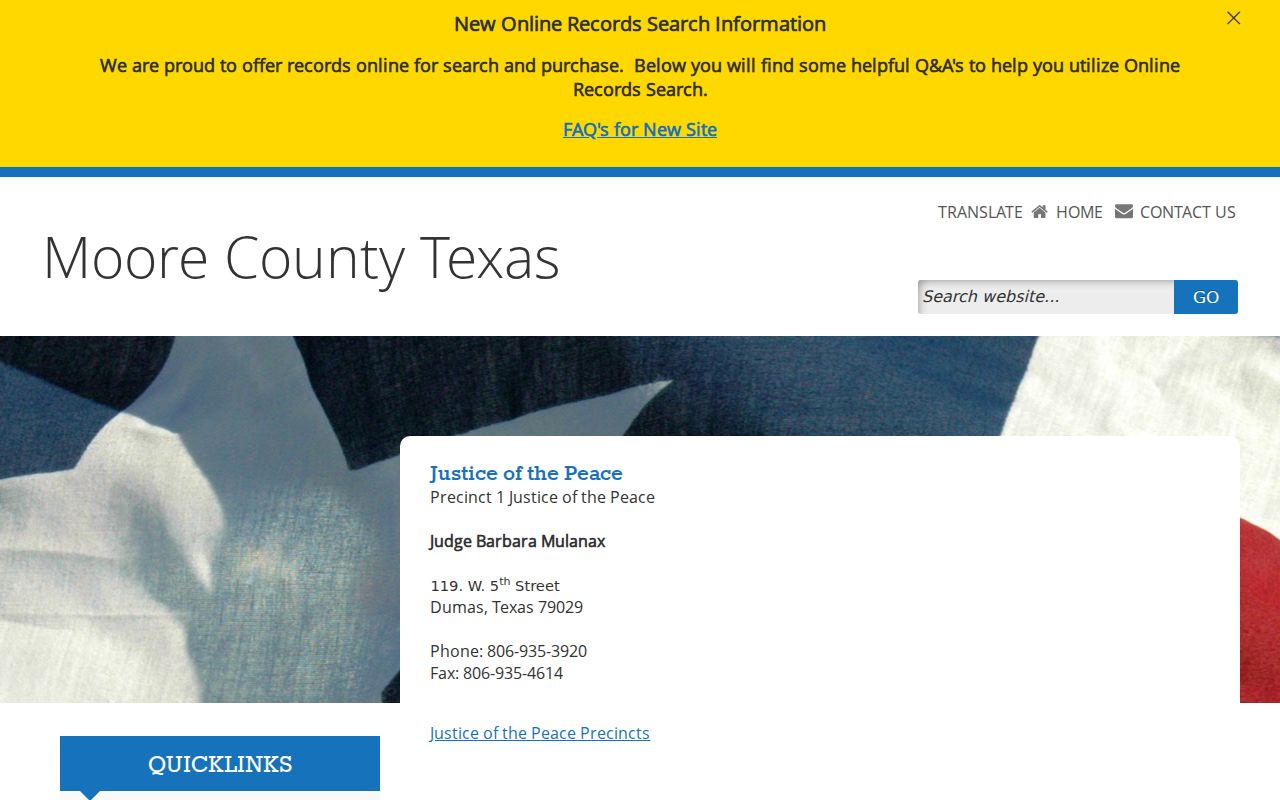
JP1 sits at 119 W 5th in Dumas, reachable at 806-935-3920. JP2 uses 116 E 5th in Sunray and 806-948-5362. Dumas, Cactus, and Sunray each run their own municipal courts for city matters. The agency that wrote the ticket does not settle venue. The court named on the ticket or notice does. A criminal appeal opens a separate cause. It goes to the Seventh Court of Appeals in Amarillo. Search that appellate docket on its own. Appellate filings do not stay visible in the trial-court view.
Moore E-Filing Is Not Search
The state-provided e-file landing page is a filing route for parties and lawyers.
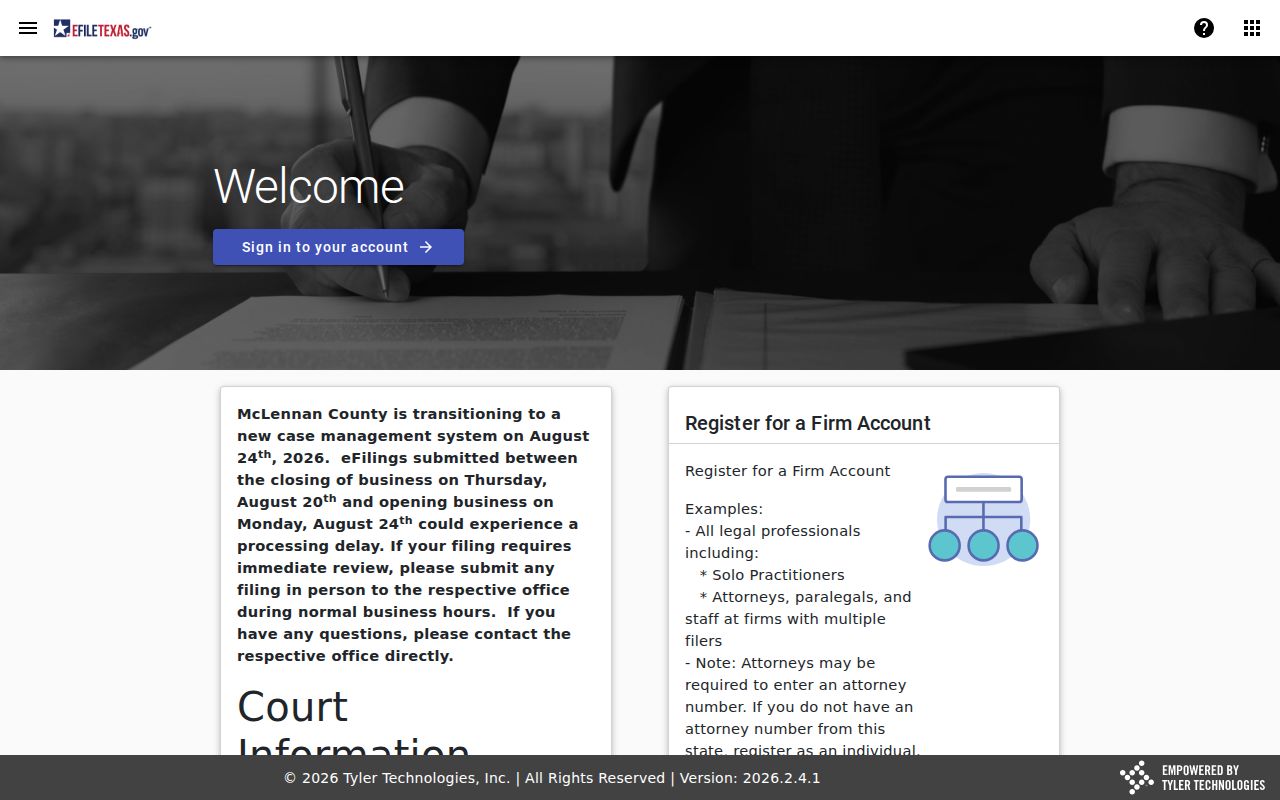
eFileTexas submits documents, nothing more. It does not replace LGS for public docket research, and a filing receipt proves only that papers went in, not that a docket entry or image is viewable yet. After submitting, track the case through the clerk and LGS.
Keep the systems separate: eFileTexas files; LGS searches local records; re:SearchTX is a statewide search layer with Moore coverage not confirmed.
Access Rules for Criminal Dockets
Adult criminal case information is often public. An order or statute can still limit access. Juvenile records follow separate confidentiality rules under Texas Family Code Chapter 58. Sealed files, protected identifiers, expunctions, and nondisclosure orders can each change what a search returns. A missing result authorizes nothing. It proves no record absent.
Access boundary: Texas Rule of Judicial Administration 12 concerns qualifying judicial records and is not a shortcut to adjudicative case files controlled by other law. Texas court rules govern sealing and redaction. Ask the clerk for the specific legal basis when access is restricted.
Moore's District Clerk page links expunction material. Expunction is a legal process that affects the record itself, not a way to scrub an online search result. Nondisclosure works through an order limiting dissemination. Neither process invites hunting for the record through guesses or alternate name spellings.
When Moore Shows No Image
Some records simply are not open to public view. The LGS FAQ says as much. It sends you to the county office where the record resides. For district criminal files, call the District Clerk at 806-935-4218. For constitutional county records, the numbers are 806-935-2009 or 806-935-6164. Questions about County Court at Law settings and routing go to 806-935-2440. Be specific when you call. Say what you want. Ask for a docket sheet, a filed document, or a plain copy. Or ask for a certified copy or a transcript. If the case is old, ask about bound volumes. Ask about indexes or microfilm too. Ask also about the current fee, accepted payment, delivery options, identification needs, and how long the request will take. The oldest digitized year is not published. Local criminal copy fees and exact Moore criminal abbreviations are not published either.
Confirm a reset directly. A historic arraignment, docket call, or trial date may no longer be current. District Court administration is the fallback for a felony setting.